From Predictive Maintenance to Cognitive Maintenance: The Brain Behind Edgemant
In today's industry and in the management of commercial buildings, the challenge is no longer just preventing things from breaking down. The real challenge is ensuring complete operational continuity with maximum efficiency. However, current systems are often "black boxes" that generate alerts without context, or rigid models that don't scale.
How can we combine the instincts of an expert engineer with the processing speed of Artificial Intelligence? This is where Edgemant's Cognitive AI comes in.
1. The Fusion of the Physical and Digital Worlds (Cyber-Physical Systems)
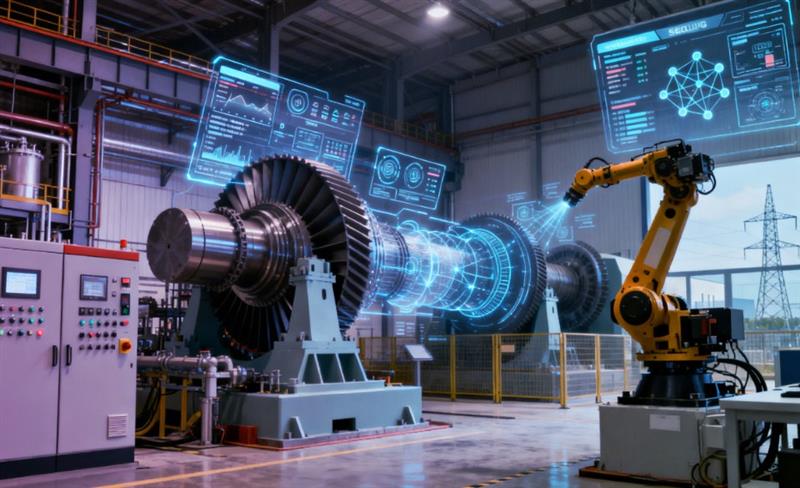
To understand Edgemant, we must first discuss Cyber-Physical Systems (CPS) . It's not just about installing sensors; it's about creating a digital representation where cyberspace understands in real time what is happening in physical space.
Edgemant captures both structured data (vibration, temperature, speed) and unstructured data (engine audio, thermal images, PDF technical manuals). By processing this information, our AI Agents don't just see numbers; they understand the why, the how, and the what of the entire system. It's the difference between seeing a red light and understanding that it came on because a specific valve lost pressure 10 minutes ago.
2. Edgemant's "Intelligence Engine": Three Layers of Execution
Our architecture is based on a solid technical thesis that combines three critical elements:
A. The Knowledge Graph
Your engineers don't just program; they create a "digital map" of the machines. If a motor overheats, the system instantly knows that this motor drives Conveyor Belt X, which is critical for shipping. The data ceases to be an isolated figure and becomes operational context .
B. Machine Learning + Time Series
Our edge devices analyze data streams in real time. AI identifies anomalies in vibration or electrical behavior long before the human eye or traditional systems can detect them.
C. The CBR (Case-Based Reasoning) Methodology
This is where Edgemant becomes invincible through the 4R cycle:
-
Retrieve: "When have we seen this vibration before?"
-
Reuse: "Three months ago, the solution was a lack of grease."
-
Check (Review): The technician applies the grease and confirms the success of the operation.
-
Retain: The AI saves the case. Next time, the solution will be suggested instantly.
3. Use Cases: From Theory to Operational Reality
-
Scenario A: The Intelligent Elevator
If an elevator vibrates, a standard AI would give you a generic alert. Edgemant tells you: "It's the bearing in motor B because the temperature rose 2 degrees before the vibration." This prevents passengers from getting trapped and reduces repair costs by up to 30%. -
Scenario B: The Industrial Water Pump
If a plant in Piura detects cavitation, the system consults its case library from a similar plant in Lurín. Result: The maintenance manager receives the precise instruction: "There's a 92% probability it's the suction valve; it was fixed in Lurín by adjusting the Y-bolt."
4. The Edgemant Lifecycle in Your Company
Adopting Edgemant is a process of constant evolution for your infrastructure:
-
Day 1: The Assistant (Anomaly Detection): The system identifies strange behaviors through symbol-driven neural reasoning, ensuring that the AI complies with safety protocols without "hallucinating".
-
Day 180: The Expert (Knowledge Base): The system now has a "medical history" for each team. You've digitized the brains of your best engineers, allowing AI to suggest solutions based on previous real-world cases.
5. Why choose a cognitive approach?
Edgemant breaks down the barrier between model-based and data-driven models. We bring together the best of both worlds: we use expert knowledge to guide the data and data to validate knowledge.
Direct Benefits:
-
Continuity of Operation: Zero unplanned downtime.
-
Sovereignty and Security: Offline and local operation. Your critical data doesn't have to go to the cloud.
-
Cost Optimization: We moved from maintenance by schedule to maintenance by operational awareness.
📞 Ready to take the next step?
Contact us to schedule a demo and/or a visit.
-
📧 Email: edgemant@conauti.com
-
💬 WhatsApp Latam: +51 997975161
-
🇺🇸 WhatsApp USA: +1 (415) 604-6499
-
🤖 Replikers: Chat with Enrique Suárez
-
📋 Form: Complete the form